
Accounting accuracy is the foundation of financial health for any business. Here are some mistakes that can derail entrepreneurs along the way:
Common Accounting Mistakes Template, Qoyod 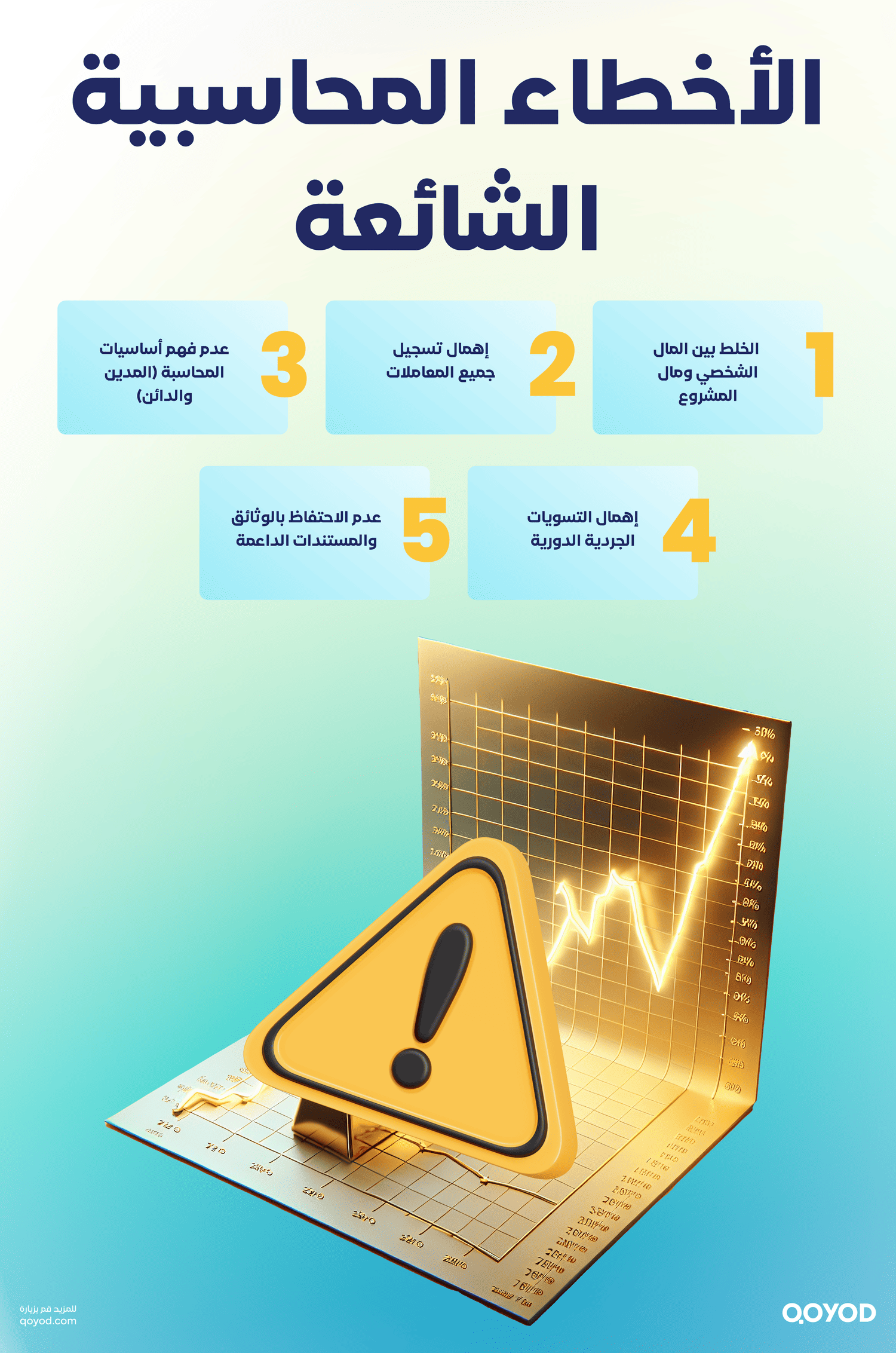
1. Mixing personal money with business money
This is one of the most common and dangerous mistakes, especially in small or early-stage businesses. Owners tend to use their personal bank accounts to pay business expenses, or withdraw business funds to cover personal costs without recording it clearly.
Why is it a mistake?
- Blurred financial picture: It becomes impossible to determine the true financial performance of the business. Is the business actually profitable, or are the available funds the result of continuous personal capital injection?
- Legal and tax issues: In the event of a financial or tax audit, the company may be deemed non-compliant, fines may be imposed, or suspicions may arise about the nature of its transactions.
- Difficulty tracking and analyzing: Revenues and expenses cannot be analyzed accurately, which hinders sound decisions on pricing, expansion, or cost reduction.
- Loss of control: It leads to an inability to track cash flows precisely, which may expose the business to sudden liquidity problems.
The fix: Open a completely separate bank account for the business, and record all transactions through it. Treat the business as a financial entity independent of you.
2. Neglecting to record every transaction
Some owners believe that recording only large transactions is what matters, or that they will remember the small ones later. This neglect, even for just a few transactions, accumulates and leads to inaccurate records.
Why is it a mistake?
- Incomplete records: It leads to incorrect financial statements that do not give a true picture of the company’s financial position.
- Difficulty reconciling accounts: It becomes hard to match bank balances or supplier balances, wasting time and effort tracking down differences.
- Lost tax deduction opportunities: You may fail to record expenses that could have been deducted, resulting in paying more VAT or income tax than necessary.
- Wrong decisions: Building decisions on incomplete data exposes the business to significant risk.
The fix: Record every financial transaction, no matter how small, the moment it happens. Use accounting software or an organized journal.
3. Not understanding accounting basics (debit and credit)
Owners may record transactions randomly without understanding basic accounting principles, such as the concept of debit and credit, or how transactions affect different account types (assets, liabilities, revenues, expenses).
Why is it a mistake?
- Unbalanced records: Leads to balances that do not match (debit not equal to credit), signaling serious recording errors that are hard to detect.
- Difficulty preparing reports: Financial statements become unreliable and unusable.
- Inability to self-audit: Without understanding the basics, owners cannot effectively review the work of accountants or accounting software.
The fix: Invest time in understanding accounting basics, especially the double-entry principle. You don’t need to be a professional accountant, but you should understand the principles your financial reports are built on.
4. Skipping periodic adjusting entries
Adjusting entries are essential at the end of each accounting period to ensure that revenues and expenses are recorded in the period they actually belong to, regardless of when cash was received or paid (the accrual principle). Skipping them leads to overstated or understated profits.
Why is it a mistake?
- Misleading financial statements: The period may show profits or losses that aren’t real. For example, revenue collected in advance for a service not yet delivered will appear as period revenue when it is in fact a liability.
- Difficulty making decisions: Building decisions on unreal profits can lead to misallocation of resources or incorrect estimates of the financial position.
- Tax issues: You may pay tax on profits not actually earned, or fail to benefit from tax deductions you are entitled to.
The fix: Run periodic adjusting entries at the end of each accounting period (monthly, quarterly, or annually) to confirm the accuracy of revenues and expenses. Consult an accountant if needed.
5. Not keeping supporting documents and records
Some owners rely on memory or digital recording alone without keeping organized physical or electronic copies of invoices, receipts, contracts, and account statements.
Why is it a mistake?
- Loss of evidence: In the event of an audit or dispute, there will be no physical evidence to support the recorded transactions.
- Difficulty tracing errors: When an error is discovered, tracing its source and correcting it becomes very difficult without the original documents.
- Non-compliance: Most regulations and laws require companies to keep accurate records and supporting documents for many years.
The fix: Keep organized copies (physical or electronic) of all supporting documents for transactions. Use organized filing systems or document management software.
Frequently Asked Questions
What is the most dangerous mistake startup owners make?
Mixing personal money with business money. Using a single bank account for personal and business expenses blurs the financial picture, makes it hard to determine real profits, and raises legal and tax suspicions about the integrity of transactions.
Why is recording “small” transactions so critical?
Because neglecting them accumulates and leads to incomplete records and misleading financial statements. You may also lose opportunities to claim tax deductions on real, unrecorded expenses, which makes you pay more tax than you actually owe.
How does ignorance of debit and credit lead to business failure?
It leads to unbalanced records and unreliable financial reports. Without understanding double-entry basics, you cannot review the work of accountants or accounting software, leaving you vulnerable to making strategic decisions based on completely wrong data.
Why do adjusting entries and supporting documents matter?
Adjusting entries ensure revenues and expenses are recorded in the correct period (the accrual principle) to prevent artificially inflating profits.
Supporting documents are your only physical evidence before regulators (such as the Zakat, Tax and Customs Authority (ZATCA)) to prove that every transaction in your books is genuine.
Conclusion: accurate accounting, an investment in your business future
Accurate accounting is not just an administrative burden or a set of complex numbers; it is a strategic investment in your business future. Accounting mistakes, however small they appear, can accumulate into financial and legal disasters that threaten business continuity. Avoiding these common mistakes requires awareness, discipline, and sometimes expert advice.
When your business accounting is managed with awareness and accuracy, it becomes a transparent window into your real performance. It lets you make decisions based on facts, not guesses. It builds the confidence of investors and lenders. And it spares you a lot of legal and tax headaches. Make accounting an integral part of your work routine, because, simply put, it is your roadmap to sustainable success.