A small business in Saudi Arabia, by ZATCA classification, runs between 6 and 49 employees and annual revenue under 40 million SAR. That covers most retail shops, service providers, light manufacturers, and professional offices in the Kingdom. The owner usually wears every hat: sales, operations, hiring, and the books. A typical small business posts 400 to 900 transactions a month between sales invoices, supplier bills, payroll, and bank movements. Without integrated accounting that gives a live cashflow view, an accurate inventory position, payroll on time, and ZATCA e-invoicing on every sale, the owner spends weekends on reconciliations instead of growing the business.
What makes small-business accounting different
A small business does not need an enterprise ERP. It needs a focused accounting platform that handles the essentials well: invoicing, inventory, expenses, payroll, and statutory filings, with a chart of accounts the owner can read without a CPA on staff. The wrong tool is either a too-simple spreadsheet or a too-heavy enterprise suite that demands a full-time bookkeeper to operate.
Small-business accounting revolves around five connected pieces: invoicing with ZATCA simplified tax invoice on every sale, basic inventory with stock-level alerts, expense capture and bill payment with bank reconciliation, payroll for a small team with GOSI and end-of-service accrual, and monthly VAT and quarterly Zakat filings ready to submit.
Daily reality is between 15 and 35 postings a day per business: customer invoices, supplier bills, petty-cash expenses, bank deposits, payroll runs at month-end, and the weekly cashflow check. The owner needs every one of these to take seconds, not minutes, or they pile up to the weekend.
The most common accounting challenges in small businesses
Every small business in Saudi Arabia runs into the same four recurring problems. They share the same gap: the owner is operating the business, no one is closing the books, and reality hits at tax filing.
1. Cashflow blind spots. A small business has 380,000 SAR in the bank, 220,000 SAR in receivables, and 165,000 SAR in payables due in 30 days. Without a live cashflow report, the owner believes the bank balance is the cash position and overspends by 90,000 SAR on inventory restocking.
2. Inventory mismatch. A retail shop holds 600 SKUs. Without barcode-based receiving and issuing, the system count drifts from physical count by 8% inside a quarter, lost sales pile up on stockouts, and dead stock takes up the back room.
3. VAT filing rushed and wrong. The owner postpones the VAT return to the deadline week, reconciles two months of bank statements in two days, and either overpays VAT or files an inaccurate return that triggers an audit notice three months later.
4. Payroll done by spreadsheet. A 12-person team gets paid by manual transfer with GOSI and end-of-service tracked on a sheet. One employee leaves, end-of-service was undercalculated, and a labor complaint costs 28,000 SAR plus reputational damage.
What a small business actually needs from its accounting software
A spreadsheet was built for ad-hoc calculation, not for posting 600 transactions a month with VAT, inventory, and payroll. The gap is concrete:
| Task | Spreadsheet or generic tool | What a small business needs |
|---|---|---|
| Invoicing | Word template | ZATCA e-invoice with QR code |
| Inventory | Manual sheet | Barcode receiving and stock alerts |
| Cashflow | Bank balance only | Live cash and receivables forecast |
| Expenses | Receipts in a drawer | Bill capture with bank match |
| Payroll | Manual transfer | GOSI and end-of-service automation |
| VAT | Quarterly scramble | Always-ready monthly return |
Beyond the table, a small business specifically needs three capabilities generic platforms do not deliver:
- One-screen dashboard with cash, receivables, payables, and stock value, so the owner sees the financial position in 30 seconds without running three reports.
- Bill capture and bank-feed reconciliation, where supplier bills upload by mobile photo and bank transactions match automatically, so the books close in hours not days.
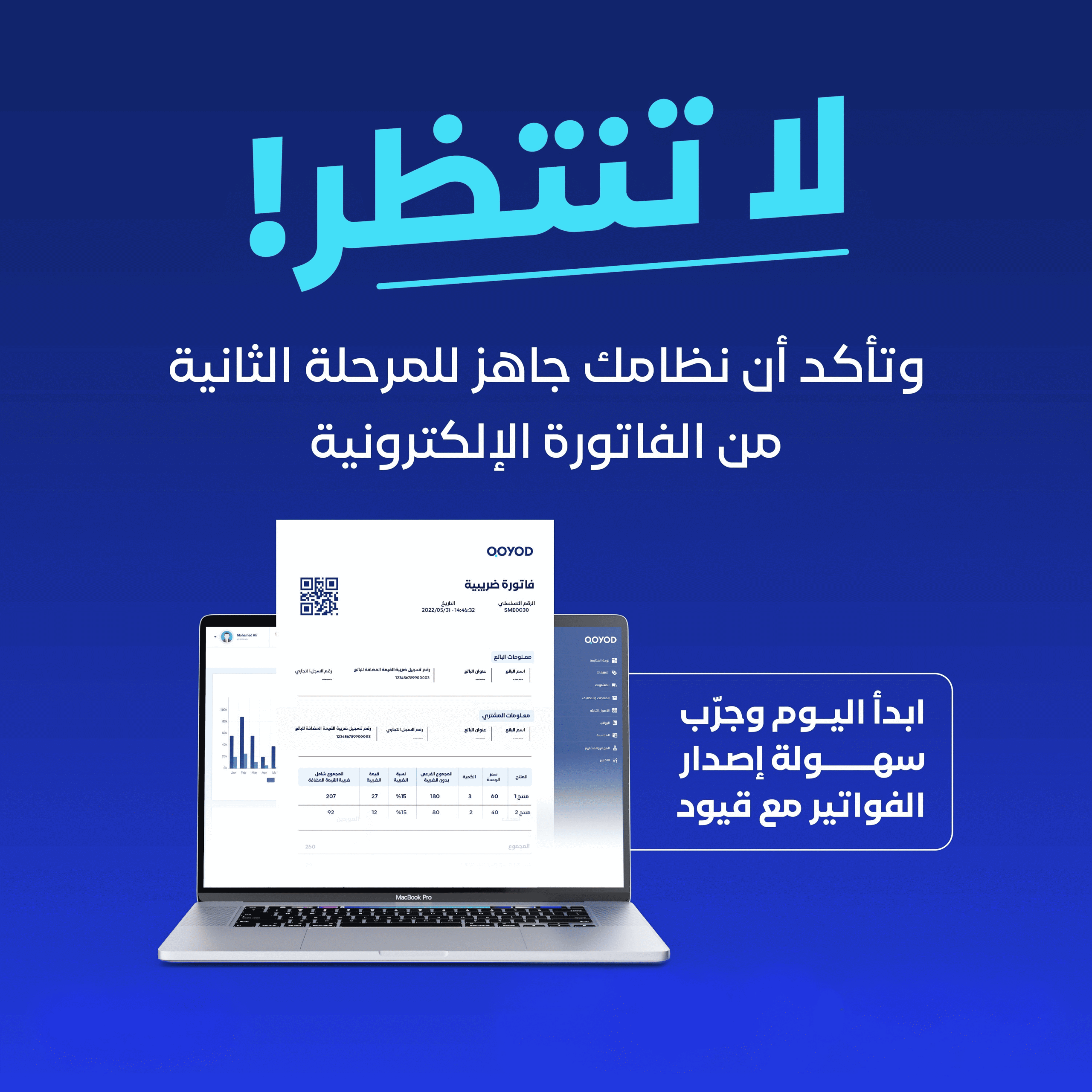
- ZATCA phase-two e-invoicing on every sale, where the simplified tax invoice fires with QR code and Reporting submission in one flow, and the monthly VAT return is always ready.
How to organize a small business’s books step by step
Moving a small business to integrated accounting takes around one to two weeks depending on transaction volume and inventory complexity. This is the sequence Qoyod applies with every new small-business customer:
E-invoicing and ZATCA compliance for small businesses
Phase two of ZATCA e-invoicing applies to small businesses by revenue threshold in scheduled waves. Most small businesses now fall inside one of the waves and must issue every sale through a certified system connected to the Fatoora platform. Retail small businesses issue mostly simplified tax invoices, while B2B small businesses issue standard tax invoices through the Clearance flow.
Every invoice must include the seller name and tax number, a sequential invoice number, the date and time, the buyer name on B2B invoices, an itemized list of goods or services with VAT at 15%, totals before and after VAT, and a QR code. A certified system generates the QR code, signs the invoice in XML, and transmits it to the Fatoora platform inside the Reporting or Clearance window.
How to evaluate ZATCA-certified accounting software for a small business
When evaluating any accounting vendor for a small business, verify these six criteria:
- Official ZATCA phase-two certification with a verifiable approval number on the Authority’s portal.
- Both Reporting (retail simplified) and Clearance (B2B standard) flows in one system.
- Per-line VAT on multi-item invoices.
- Bank-feed reconciliation with major Saudi banks.
- Long-term cloud storage of signed invoices for at least six years.
- Always-ready VAT return without month-end scramble.
Where Qoyod fits in specifically for small businesses
Qoyod brings together, inside one account: cloud accounting with a small-business chart of accounts, ZATCA-approved e-invoicing, basic inventory with barcode receiving, bill capture with bank-feed reconciliation, payroll with GOSI and end-of-service, and always-ready VAT and Zakat returns. Every sale, supplier bill, bank movement, and payroll run lands an automatic journal entry inside the same ledger.
The platform handles single-branch and multi-branch small businesses under one account, with shared master data (chart of accounts, inventory, customers, suppliers), role-based permissions per branch, and either consolidated or per-branch reports. It runs entirely in the cloud, so the owner, the bookkeeper, and the external accountant share the same numbers from any device.
For small businesses migrating from spreadsheet bookkeeping or a legacy desktop system, the setup service and the bookkeeping service are available as part of Qoyod Pro Services, alongside the app marketplace for connecting to bank feeds, POS, and CRM partners.
Frequently asked questions
Is Qoyod the right size for a small business?+
Does Qoyod handle ZATCA e-invoicing for small businesses?+
Can Qoyod track basic inventory?+
Does Qoyod do payroll for a small team?+
Does Qoyod do bank reconciliation?+
Is technical support available 24/7?+
Running a small business does not need an enterprise ERP, it needs a focused operating ledger that ties cashflow, invoicing, inventory, bills, payroll, and ZATCA e-invoicing together inside one account. The small businesses that consistently grow are the ones that see cash and receivables every week. That capability is what makes Qoyod the right fit for small businesses in Saudi Arabia.